This resource hub is for healthcare providers involved in cervical screening. It houses provider and patient facing educational resources to support the delivery of the National Cervical Screening Program, including screening for priority populations. Further down the page you’ll find links to our online courses page and screening information in different formats.
An information sheet for clinicians and patients, with step-by-step, illustrated instructions.
How to take your own HPV test (25 languages)
An information sheet for clinicians and patients, with step-by-step, illustrated instructions available in 25 languages.
Cervical Screening: Supporting your patients to make the choice
An information sheet for clinicians comparing screening options (clinician–collected sample compared to self-collected).
Self-collection is accurate
An information sheet for clinicians, outlining Arbyn’s (2018) research, demonstrating the accuracy of self-collected samples.
Top 10 self-collection frequently-asked-questions
A 2-page clinician-facing resource answering the top 10 frequently asked questions on HPV self-collection.
Healthcare Practitioner’s Guide to Home Based Self-collection
A 1-page, clinician-facing guide to supporting your patientsto access VCS Pathology’s home-based self-collection servicevia telehealth
Cervical screening (general)
National Cervical Screening Program Quick Reference Guide
A 2-page, clinician-facing resource with the illustrated National Cervical Screening Program pathway and supporting information.
2025 Updates to the National Cervical Screening Program Guidelines
This two-page resource explains changes to the NCSP Guidelines made in 2025 which are most relevant for primary care.
HPV and cervical screening
A 2-page resource to aid discussion with patients about the nature of HPV and its link to cervical cancer.
Screening Specific Populations
Guidelines for screening in pregnancy, immune-deficiency and women exposed to DES in utero.
Investigation of abnormal vaginal bleeding and screening after hysterectomy
Management of patients with abnormal vaginal bleeding and following total hysterectomy.
Information for your next Cervical Screening Test – English
An information sheet for patients, with options for cervical screening, what happens after a test, and how to self-collect.
Navigating the intermediate risk pathway
An information sheet outlining the considerations for the use of HPV self-collection.
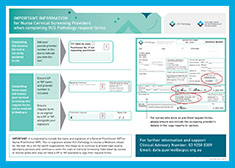
Important information for Nurse Cervical Screening Providers
A 1-page resource which steps you through important considerations when completing VCS Pathology request forms.
Cervical screening in pregnancy
A 2-page resource outlining considerations for screening women during pregnancy
The National Cervical Screening Program: Key information for Health Professionals
A 16-page, comprehensive information pack for clinicians, overviewing the key aspects of the National Cervical Screening Program, with several illustrated resources included.
Cervix Sampling Card
A 2-page, illustrated, clinician-facing resource with recommended techniques and instruments for taking a cervical sample, as well as images of cervical appearances.
What do my results mean – unsatisfactory
For patients, when results indicate that the laboratory has been unable to complete testing for technical reasons.
What do my results mean – low risk
For patients, when testing returns a negative result for HPV.
What do my results mean – intermediate risk
For patients, when test results indicate the presence of an HPV infection, but there are no findings to suggest that further treatment is necessary.
What do my results mean – higher risk
For patients, when test results indicate the presence of an HPV infection that may be associated with cell changes that require treatment.
Working with Aboriginal and Torres Strait Islander patients
NCSP website
Visit the NCSP website for information and resources on how to engage Aboriginal and Torres Strait Islander patients in cervical screening.
Instructional video
This video is for Aboriginal and Torres Strait Islander women. It explains how to take your own Cervical Screening Test sample.
How to take your own cervical screening test
An information sheet for clinicians and patients, with step-by-step, illustrated instructions.
Common Questions
A tailored resource for Aboriginal and Torres Strait Islander patients answering common questions about cervical screening.
Working with Culturally and Linguistically Diverse patients
How to take your own HPV test (25 languages)
An information sheet for clinicians and patients, with step-by-step, illustrated instructions available in 25 languages.
NCSP website: Translations of cervical screening resources
More translated resources are available on the National Cervical Screening Program website.
NCSP website: Patients from CALD backgrounds
Find information and resources on how to engage patients from culturally and linguistically diverse backgrounds in cervical screening.
Information for your next Cervical Screening Test (multi-language)
An information sheet for patients, with options for cervical screening, what happens after a test, and how to self-collect. Available in 7 languages.
Working with people of diverse sexualities and genders
TransHub: for clinicians
More resources to strengthen the clinical care delivered to transgender people
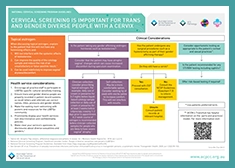
Cervical screening is important for trans and gender diverse people...
Resource for healthcare providers
NCSP Website
Find information and resources on how to engage patients of diverse sexualities and genders backgrounds in cervical screening.
The ACPCC offers free, CPD-endorsed online courses for healthcare providers, aimed particularly at GPs and nurses. Delivered through the GPEx online learning platform, you can complete these in your own time and at your own pace.
educational video
Taking a Cervical Screening Test
Watch our instructional video, designed to help practitioners take good quality Cervical Screening Tests.
educational video
Supporting your patients to make the choice
This 12-minute video demonstrates how you can incorporate self-collection into your practice, and outlines the important points to discuss with patients to support them to make an informed choice about how they screen.
Webinar: Get-the-Facts
This webinar discusses what you and your patients need to know about self-collection. We help you understand the evidence behind self-collection, equip you with the tools you need to effectively support patients to make an informed choice about this screening method, and support you to better engage those who are reluctant to screen. Suitable for GPs, nurses, midwives and other healthcare providers with an interest in cervical screening.
Podcast: Dispelling myths about HPV self-collection in cervical screening
Podcast featuring Prof Marion Saville AM discussing the reliability of self-collection with Dr Terri Foran, medical educator.
Laboratory processing of
Self-Collected samples
Not yet set up to offer the choice of self-collection? To get ready, contact your pathology provider to:
confirm that they can process self-collected vaginal samples, or will send them on to one that does
order the correct collection device and other consumables
confirm any collection, handling and transport requirements.