The Elimination Strategy
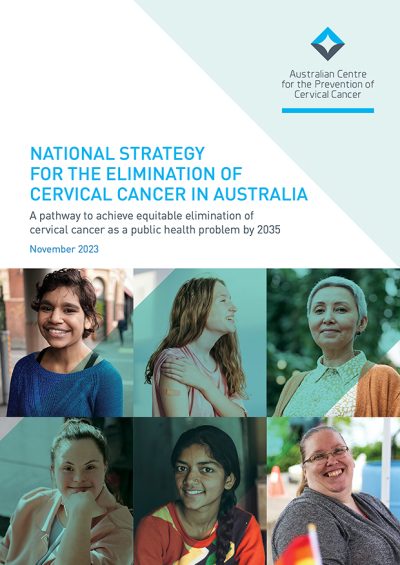
The National Strategy for the Elimination of Cervical Cancer outlines Australia’s commitment to achieving equitable elimination of cervical cancer as a public health problem by 2035, and the objectives and actions needed to achieve this goal.
Cervical Cancer Elimination by 2035
Vision: An Australia were preventable cervical cancer is a disease of the past, in which Australia’s diverse communities have equitable access to information and to culturally safe and inclusive vaccination, screening and treatment services.
Priority populations
The strategy calls for the delivery of a positive, culturally safe and inclusive experience of prevention and care, with focus on the following priority populations:
- Aboriginal and Torres Strait Islander people
- Culturally and linguistically diverse people
- People who are LGBTQ+ and people who are intersex
- People with disability
- People living in rural and remote areas
Australia’s 2030 cervical cancer elimination targets
Timely and accurate cervical cancer incidence and mortality data
WHO Targets
Incidence = < 4 new cases per 100,000
Strategic Targets
Incidence = < 4 new cases per 100,000
Strategic Objectives
Ensure that Australia has access to timely and accurate cervical cancer incidence and mortality data
Vaccination
WHO Targets
90% of girls to be fully vaccinated with the HPV vaccine by 15 years of age
Strategic Targets
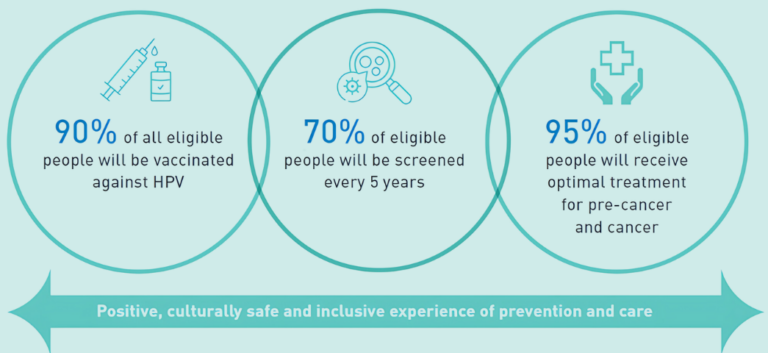
90% of all eligible people will be vaccinated against HPV
Strategic Objectives
- Optimise the delivery of school-based HPV immunisation programs in all jurisdictions to maximise equity and achieve high coverage.
- Optimise the reach and funding of complimentary out-of-school immunisation programs to achieve equity in delivery for all, including priority and medically high-risk populations (catch-up).
- Develop a method to enable annual reporting of HPV vaccination coverage for priority and medically high-risk populations to monitor equity in immunisation.
Screening and pre-cancer treatment
WHO Targets
70% of women to be screened (twice) by 35 and again by 45 years of age using a high precision test i.e., an HPV PCR-based test
Strategic Targets
70% of eligible people will be screened every 5 years
Strategic Objectives
- Promote cervical screening regularly with the public and strategically with under-screened groups.
- Increase access to screening, colposcopy and follow-up by expanding who can offer these services, and where and how they are offered, to improve reach and uptake.
- Collect, use, and release data to enable and monitor equity of access to cervical screening and pre-cancer treatment services.
Treatment
WHO Targets
90% of women identified with cervical disease to receive treatment for pre-cancerous lesions or management of invasive cancer.
Strategic Targets
95% of eligible people will receive optimal treatment for pre-cancer and cancer.
Strategic Objectives
- Ensure communities and patients have equitable access to quality information about cervical cancer symptoms and that each cancer patient has tailored information about their diagnosis, intended treatment and planned optimal care pathway.
- Develop and implement a road map of coordinated care, with communities of practice, to optimise the delivery of safe, quality care to all patients.
- Drive improvements in cervical cancer management through a data collection framework supporting systemic monitoring and enhancement of the quality of care, in alignment with Australian Cancer Plan.
Australia and the global cervical cancer elimination journey.