Victorian Cancer Screening Annual Statistical Report
creativeneko via canva.com
The interactive online report presents insights into cervical, bowel, and breast cancer screening programs in Victoria, including key indicators such as participation or coverage rates, cervical screening test self-collection uptake, and time to assessment.
The Report
The Victorian Cancer Screening Annual Statistical Report integrates key cancer screening data up to 2024 from:
- the National Cervical Screening Program
- the National Bowel Cancer Screening Program
- the BreastScreen Victoria dataset.
The Australian Centre for Prevention of Cervical Cancer (ACPCC) is funded by the Victorian Department of Health to deliver this report under the Victorian Cancer Screening Framework (VCSF).

What’s new this time around?
- The bowel participation measure has been included in the report for the first time.
- Data have been refreshed for screening numbers (breast, bowel and cervical), breast participation, cervical coverage, and time to assessment (bowel and cervical).
Some Key Insights
Cervical Screening
- By the end of 2024, self-collected tests represented 35.5% of all HPV screening tests, increasing from 21.5% in 2023. Self-collection has been an available option to all participants since 1 July 2022.
- The highest uptake of cervical screening test self-collection was observed in the under-screened (50.1%) and never-screened people (43.50%) compared with people who screen on-time (32.97%) suggesting that self-collection has been effective at reducing barriers to accessing cervical screening among under-screened and never-screened populations.
- Overall, there has been a 1% decline in 5-year coverage rate for cervical screening in Victoria, consistent with national trends.
Breast Cancer Screening
- In 2024, an unprecedented 255,189 eligible women aged 50-74 had a screening mammogram, the highest annual total to date, and an increase of 6% compared to 2023.
- 51.9% of eligible women aged 50-74 participated in the BreastScreen program in 2022-2024 FY.
- With participation rates continuing to increase among women aged 50–74 closer to what they were before the pandemic, future focus will be on increasing participation in priority population groups, including multicultural communities, Aboriginal and Torres Strait Islander people and women with a disability.
Bowel Screening
- 44.2% of eligible participants aged 50-74 participated in bowel screening in 2023-2024.
- Participation rates were notably lower among younger age groups. Additionally, no age group met the Victorian Cancer Plan target of at least a 60% participation rate. These data suggest that more targeted interventions are required to improve participation rates across the entire eligible population.
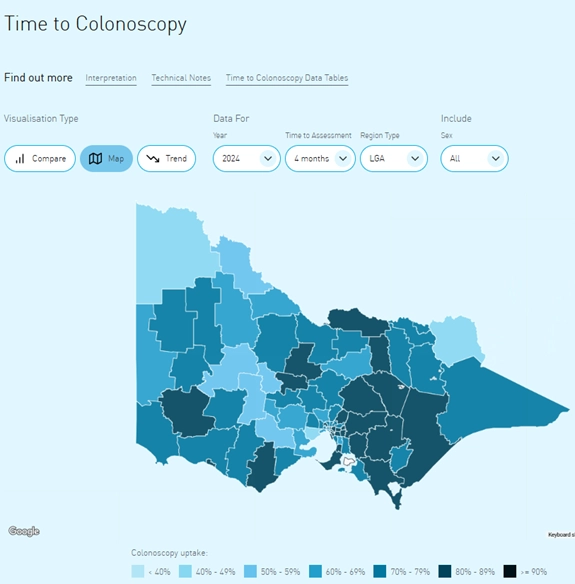
- 76% of participants returning positive are receiving timely assessment (colonoscopy).
- Timely colonoscopy is crucial for detecting bowel cancer at an earlier stage with 90% of bowel cancers successfully treated if detected early. Ongoing efforts are required at both the health systems and individual level to ensure participants have timely access to, and understand the importance of, colonoscopy for detection of bowel cancer at an earlier stage for improving health outcomes.
Contributing organisations
The Victorian Cancer Screening Annual Statistical Report is an output of the VCSF and a collaboration of all VCSF partners:
- ACPCC
- Breast Screen Victoria
- Cancer Council Victoria
- Department of Health, Victoria
- Victorian Aboriginal Community Controlled Health Organisation
With support from the Victorian Government, these organisations are striving to improve prevention and early detection of Breast, Bowel and Cervical cancers in Victoria, particularly among priority communities.
Issues with the report?
Please contact our data and reporting team if you encounter any issues or have any feedback regarding the report.