2025 updates
to the National Cervical Screening Program Guidelines
This resource covers updates to the National Cervical Screening Program Guidelines, relevant to general practice. These 2025 NCSP guideline updates are effective from 14 April.
To assist you in understanding the 2025 NCSP guideline updates, the ACPCC has developed this comprehensive resource that highlights the updates relevant for general practice. We encourage you to review this resource to stay informed and prepared. Thank you for your continued support and dedication to improving cervical screening practices.
2025 NCSP guideline updates: Key changes
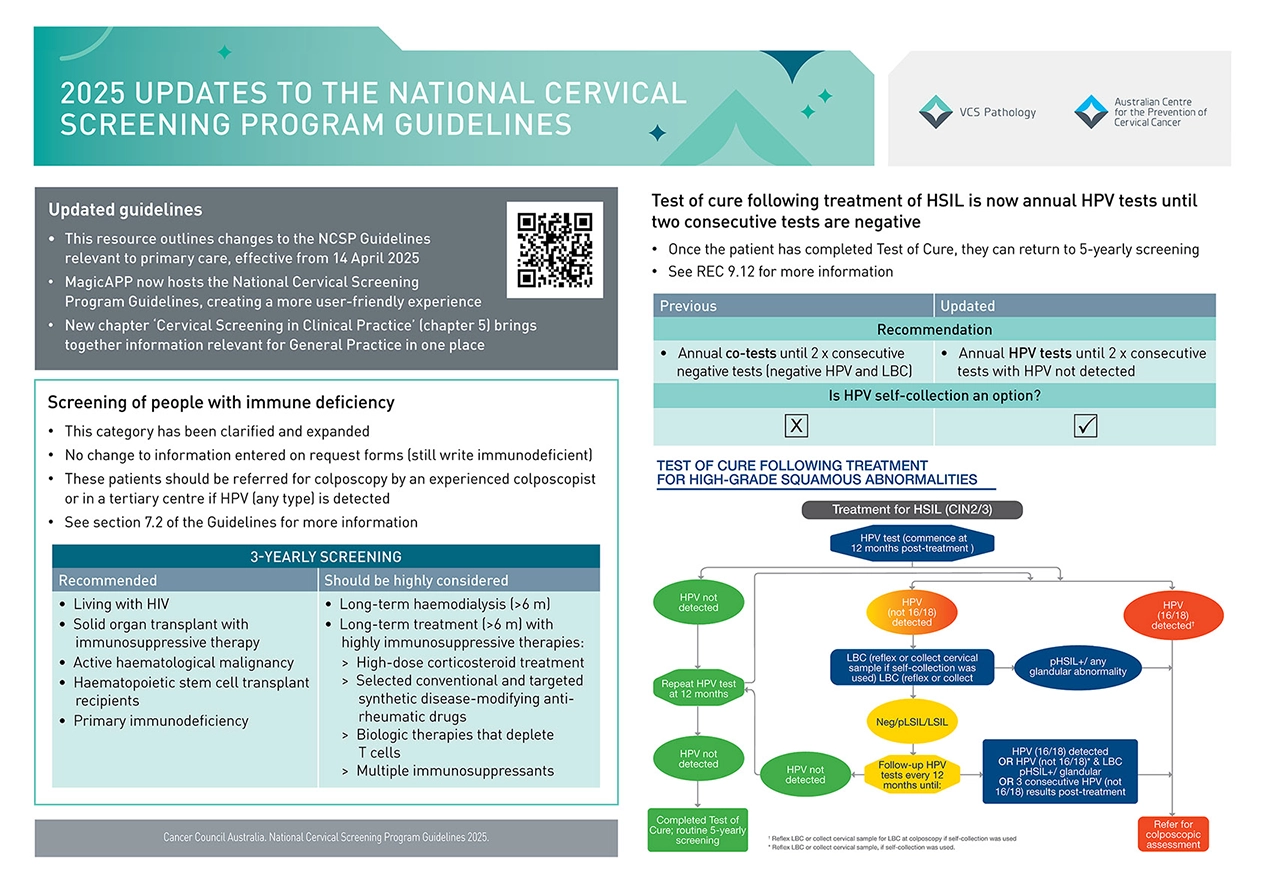
Screening of people with immune deficiency
- This category has been clarified and expanded
- No change to information entered on request forms (still write immunodeficient)
- These patients should be referred for colposcopy by an experienced colposcopist
or in a tertiary centre if HPV (any type) is detected - See section 7.2 for more information on this NCSP Guideline update
Test of cure following treatment of HSIL
- is now annual HPV tests until two consecutive tests are negative
- Once the patient has completed Test of Cure, they can return to 5-yearly screening
- See REC 9.12 for more information on this NCSP Guideline update
Repeat self-collection at 9-months for patients who do not return for LBC
- LBC is recommended when HPV (not 16/18) is detected to determine risk and further management
- If initial test was self-collected return within 6 weeks for LBC
If patient does not return until 9-months or more after initial HPV test:
- Offer a follow-up self-collected HPV test, rather than LBC
- This will determine if HPV infection has cleared, and patient can return to routine screening
- See REC 6.6 for more information on this NCSP Guideline update
Screening after total hysterectomy
- Simplified to annual testing
- Co-test or HPV test depending on cervical pathology and history > Until 2 x negative tests on 2 x consecutive occasions
- See section 7.4 for more information on this NCSP Guideline update
Surveillance following excisional treatment of adenocarcinoma in situ (AIS)
- Requires annual co-tests
- Refer for colposcopy if any abnormal result
- Interval can now be extended to 3 years if all co-tests are negative for 5 years
- If all tests are negative for 25 years:
> Return to routine screening (if <70 yo)
> Exit the program (if ≥ 70 yo) - See REC 9.20 for more information on this NCSP Guideline update
Get in touch
To find out more about what we do or how we can work together, please get in touch.